Runoff peaks in June across most of the mountain valleys, and for anybody flooding a hay meadow off a ditch, that means water is cheap and plentiful for a few short weeks. The trouble is the same calendar that fills the ditch also brings first cutting. Water too long and you cut a bog. Pull it too early and you leave the last irrigation of the season on the table right when the grass is bulking up. Getting that overlap right is most of the game on wild-flood ground.
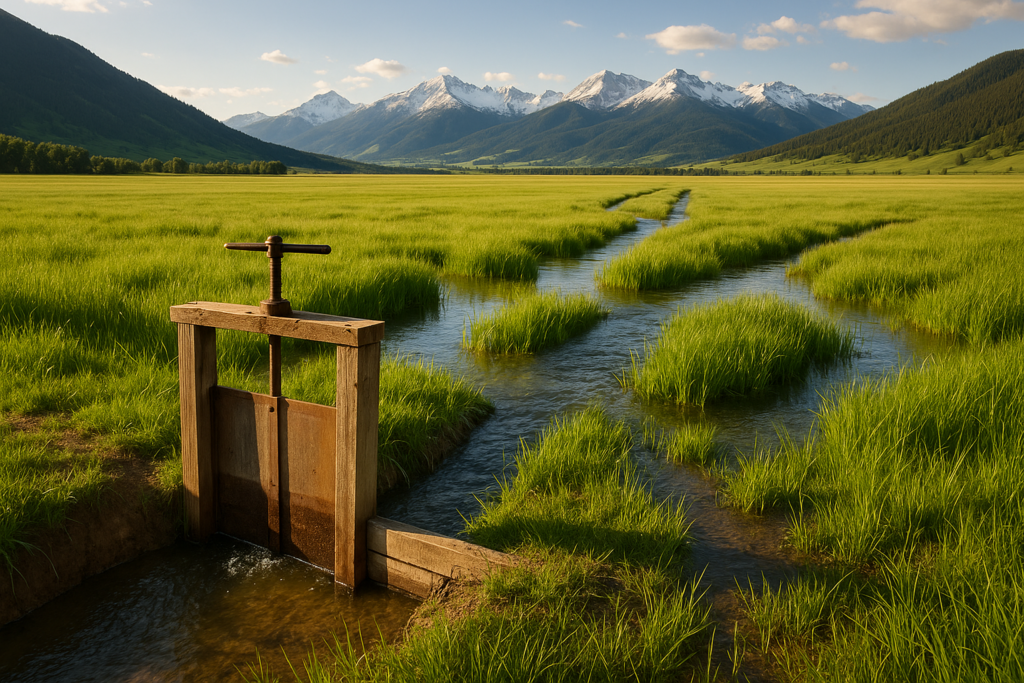
A lot of Montana hay is still put up on native meadows watered by gravity — a headgate, a main ditch, and a set of spreader ditches that walk the water across the field until it soaks in or runs off the low end. It’s cheap to run and forgiving in most years. Where it bites people is the shutoff. Sub-irrigated bottom ground and heavy meadow soils hold water for days after you close the gate, and that’s the part that decides whether your swather floats or sinks.
Read the low end before you read the calendar
The high end of a flood meadow dries first and the tail end stays wet, so cutting decisions get made off the wettest ground, not the driest. Walk the bottom of the field, not the road side. If your boot heel leaves standing water in the track, the swather will make a rut you’ll feel for two more cuttings and every year after. Soft ground doesn’t just risk a stuck machine — it lets the header push grass into the mud instead of cutting it clean, and it packs ruts that dry into washboard.
Give heavy meadow soil a week to ten days to firm up after the last water, longer in a cool, cloudy stretch. Sandy or gravelly bottoms shed water faster and can be closer to a few days. Nobody can hand you a number that fits every field. The point is to plan the shutoff backward from when you want to cut, not forward from when the ditch happens to be full.
Spread it even or you cut two crops at once
The other quiet killer on flood ground is uneven coverage. When the water follows the same three low runs every year and skips the ridges between, you end up with lush, late grass in the wet streaks and short, headed-out grass on the dry backs. Cut that field on one day and half of it is prime and half is past. You can’t fix that at the swather — it’s set with the shovel in May and June.
Clean your spreader ditches and knock down the muskrat runs and gopher mounds that pull water off course. Move the sets often enough that the whole width gets wet before you march the water on down the field. On big flat meadows, a few temporary dams of canvas or plywood in the main ditch do more to even out a crop than any amount of extra water dumped on the low end.
- Watch your tail-water. Water running off the bottom end of the field is grass you paid for and gave to the creek. If the low end runs steady, your sets are too big or you’re leaving them on too long.
- Mind the neighbor and the call. June is when senior rights get exercised and ditch riders shut people off. Know where you stand before you count on that water for a last soaking.
- Don’t chase one more irrigation into cutting. An extra flood the week before you swath rarely adds enough tonnage to pay for a bogged machine and a rutted meadow.
The last water is the one that matters
On meadow hay, the irrigation that builds the crop is the one that soaks in during the boot-to-heading stretch, not the one you sneak on at the buzzer. Time your final set so the ground is saturated deep, then let it draw down. That deep moisture carries the grass through the cure and gives the roots something to work with for regrowth after you bale.
Once the hay is off, the same discipline pays a second time. Aftermath flooding on a firm, cut meadow greens up fast in July, and a field that was watered even the first time comes back even the second. The mistakes you make with the shovel in June show up twice — once in the windrow and once in the fall pasture.
Flood irrigating looks like the simplest thing on the ranch, and it mostly is. But the difference between a clean, dry cutting and a torn-up bog usually comes down to one decision made a week ahead of the swather, with a boot in the wet end of the field.